An AI safety firm is hiring researchers to monitor the communities fighting data centers.
The job posting is on the public record. The methodology section describes monitoring you by name, post by post. We track the same projects, the same fights, the same organizers — but the work is for anyone with an email address, not for the companies behind the projects.
On April 29 we wrote about a LinkedIn posting from 10a Labs — a threat-intelligence firm that lists “frontier AI labs, AI unicorns, Fortune 10 companies, and leading global technology platforms” as its clients — for a research analyst on a project they call Data Center Watch.
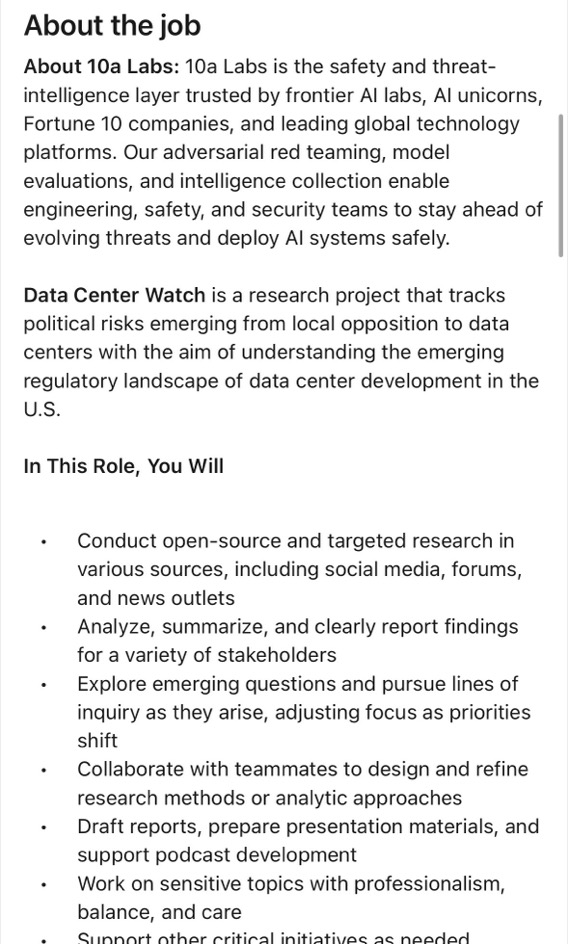
Excerpt from the LinkedIn posting · linkedin.com/jobs/view/4399541348
The role, in their words: track “political risks emerging from local opposition to data centers.” The methods:
“Conduct open-source and targeted research in various sources, including social media, forums, and news outlets... Analyze, summarize, and clearly report findings for a variety of stakeholders... Explore emerging questions and pursue lines of inquiry as they arise... Work on sensitive topics with professionalism, balance, and care.”
The output: “reports for a variety of stakeholders.” The stakeholder list, per 10a Labs's own marketing: frontier AI labs, AI unicorns, Fortune 10 companies, and leading global technology platforms.
If you have spoken at a town council meeting about a data center, posted in a Facebook group organizing against one, or signed your name to a petition opposing a rezoning — this job is being posted because of you. The methodology section describes monitoring you by name, post by post.
10a Labs describes itself as the “safety and threat-intelligence layer trusted by frontier AI labs, AI unicorns, Fortune 10 companies, and leading global technology platforms.” They sell “adversarial red teaming, model evaluations, and intelligence collection” to engineering, safety, and security teams at AI companies.
In the Data Center Watch job's phrasing, intelligence collection extends from adversarial AI testing to surveilling community opposition to the physical infrastructure the AI runs on. The same firm. The same methodology. A different category of subject.
The job description is at linkedin.com/jobs/view/4399541348 and the firm's site is at 10a.io.
When the people who profit from data centers start paying outside contractors to watch the people fighting them, that tells you the fight is real. It also tells you why making the receipts public matters — so the asymmetry of who-knows-what does not run only one way.
For two years before this job posting hit LinkedIn, the communities organizing against data centers had no shared infrastructure for tracking the projects, the developers, the political-money flows, or the wins. They each fought their own fight, often with the same developers, often using the same playbook, often without knowing the playbook had been used before.
On the industry side, that infrastructure was being quietly assembled. Now it has a name, a job posting, and a methodology section.
We track the same projects, the same fights, the same organizers. The difference is who the work is for. 10a Labs's reports go to the companies behind the projects. Ours go to anyone with an email address.
Every published project is verified against public records using a two-source rule. Every politician accepting industry money has the dollars and the committees on file. Every community win — denied, canceled, withdrawn, frozen by moratorium — is on one timeline. None of it is for sale to a Fortune 10 client. It is for the family living next to the substation, the council member voting on a rezoning, the journalist writing about water rates, and the organizer trying to keep a town from becoming a server farm.
The asymmetry of who-knows-what is the whole reason this site exists.
Three places to start, depending on what you came here for:
Ten tactics that have actually stopped data centers, drawn from real fights. Free, no signup.
Every published project rolled up across all 50 states. Top states by load, biggest projects on file, status pipeline.
Super PACs, corporate PACs, the state-by-state ledger of who is spending against rate-payer protections and community fights.
If you organize against a data center and have been approached for an interview, a survey, or by someone identifying as a researcher — we want to hear from you. poweredbywho.com/tips